Guide · 9 min read
What is a fable?
A fable is a short story, usually with animals that talk and act like people, that teaches a moral lesson. The best-known fables are credited to Aesop of ancient Greece, such as The Tortoise and the Hare, whose moral is “slow and steady wins the race”.
 By Pyxino ·
On this page
Five signs of a fable
A fable has five signs: it is short, its characters act like people, it has one simple problem, a choice decides the ending, and it teaches a moral. The word comes from the Latin fābula, “story”.
- It is short.A minute or two aloud: a few lines, one scene, no side plots.
- Animals act like people.They talk and think, and each stands for one trait: the sly fox, the proud hare.
- One simple problem.A race, a hungry winter, a piece of cheese: one situation that forces a choice.
- A choice leads to its result.The proud hare naps and loses. The ending follows from what the character did.
- It ends with a moral.A clear lesson, often one line at the end, or left for the reader to find.
The characters are not always animals: a fable can also star plants, objects or forces of nature, as The North Wind and the Sun does.
A fable in one minute: The Tortoise and the Hare
The Tortoise and the Hare, credited to Aesop, is a classic example of a fable: it is short, the animals talk, there is one race, and the hare’s pride decides the ending.
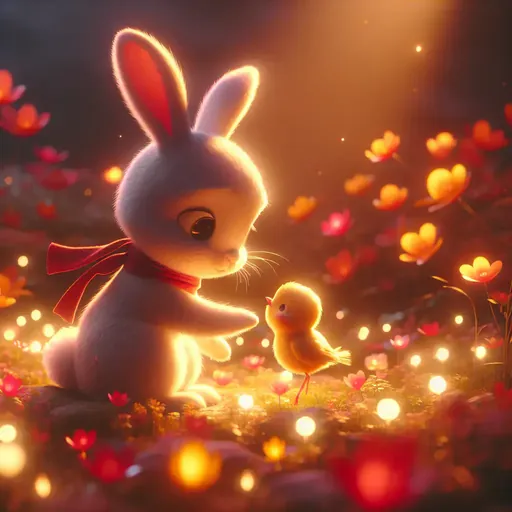
A hare laughs at a tortoise for being slow, so the tortoise challenges him to a race. The hare dashes ahead, and he is so sure of winning that he lies down for a nap halfway. The tortoise keeps walking, one steady step after another, past the sleeping hare. When the hare wakes up, he runs as fast as he can, but the tortoise has already crossed the finish line.
Moral Slow and steady wins the race.
Read our retelling: The Rabbit and the TortoiseRead our retelling: The Race in the Magical Meadow
What are the most famous fables and their morals?
The most famous fables include The Tortoise and the Hare, The Boy Who Cried Wolf and The Lion and the Mouse, all credited to Aesop; India’s Panchatantra and France’s La Fontaine added many more.
| Fable | Moral | From |
|---|---|---|
| The Tortoise and the Hare | Slow and steady wins the race. | Aesop |
| The Boy Who Cried Wolf | Nobody believes a liar, even when they tell the truth. | Aesop |
| The Lion and the Mouse | No act of kindness is ever wasted; little friends can be great friends. | Aesop |
| The Ant and the Grasshopper | Work today and you will be ready for tomorrow. | Aesop |
| The Fox and the Grapes | It is easy to scorn what you cannot have. | Aesop |
| The Crow and the Pitcher | Little by little does the trick. | Aesop |
| The North Wind and the Sun | Kindness wins where force fails. | Aesop |
| The Goose That Laid the Golden Eggs | Greed can lose everything. | Aesop |
| The Fox and the Crow | Beware of people who flatter you. | Aesop |
| The Town Mouse and the Country Mouse | A simple life in peace is better than riches in fear. | Aesop |
| Belling the Cat | An idea is easy; carrying it out is hard. | Odo of Cheriton, about 1200 |
| The Milkmaid and Her Pail | Don’t count your chickens before they hatch. | La Fontaine |
| The Monkey and the Crocodile | Quick thinking can get you out of danger. | Panchatantra |
Which everyday sayings come from fables?
Many everyday English sayings come from fables, among them “sour grapes”, “to cry wolf” and “the lion’s share”.
| Saying | What it means | The fable |
|---|---|---|
| Sour grapes | Scorning something you cannot have | The Fox and the Grapes |
| To cry wolf | To give a false alarm | The Boy Who Cried Wolf |
| The lion’s share | The biggest part of something | A lion divides a catch (Aesop) |
| To bell the cat | To take on a very difficult task | Belling the Cat |
| Don’t count your chickens before they hatch | Don’t rely on what has not happened yet | The Milkmaid and Her Pail |
Where do fables come from?
Fables come from very old storytelling traditions in ancient Greece and India, where they were told aloud long before anyone wrote them down. Aesop is said to have been an enslaved storyteller of the sixth century BC, but World History Encyclopedia notes that no writings by him survive, and today’s scholars doubt he invented every fable credited to him.
| When | Who | What happened |
|---|---|---|
| 4th century BC | Demetrius of Phalerum, Athens | The earliest collection on record: ten books of fables for speakers. No copy survives. |
| About 2,000 years ago | The Panchatantra, India | Animal fables in Sanskrit, attributed to Vishnu Sharma, teach young princes. |
| About the 1st century AD | Phaedrus and Babrius | Put the Aesop fables into Latin and Greek verse. |
| 8th century | Kalila and Dimna | The Panchatantra travels into Arabic. |
| 1484 | William Caxton | Prints the first Aesop in English, on 26 March. |
| 1668–1694 | Jean de La Fontaine, France | Retells Aesop in verse and sees the moral as the soul of a fable. |
| 1809–1843 | Ivan Krylov, Russia | Publishes about two hundred fables. |
| 1940 and 1945 | James Thurber and George Orwell | Fables for Our Time and Animal Farm use the old form for modern times. |
| 1981 | Arnold Lobel | His book Fables wins the Caldecott Medal. |
What is the difference between a fable and a fairy tale, myth or parable?
A fable is very short and built to teach one lesson, usually with talking animals, while a fairy tale is longer and full of magic, a myth explains the world through gods, and a parable teaches with human characters.
| Kind of story | What it is | Usual characters | Example |
|---|---|---|---|
| Fable | A very short story told to teach one lesson, its moral | Talking animals | The Tortoise and the Hare |
| Fairy tale | A story of magic and wonder, often ending “happily ever after” | Princesses, witches, fairies, giants | Cinderella |
| Folktale | Any traditional story passed down by word of mouth | Ordinary people, tricksters, animals | Anansi stories |
| Myth | A sacred story that explains the world, nature or the gods | Gods and heroes | The Greek myths of Olympus |
| Legend | A story of a person or place, told as if it might be true | Heroes, kings, saints | Robin Hood |
| Parable | A short story of everyday life that teaches a lesson | People rather than animals | The Blind Men and the Elephant |
A story can be both: many fables are also folktales, told aloud for centuries before anyone wrote them down.
Why are fables good for children, and at what age?
Fables are good for children from about age four, because they are short, their lesson is clear, and talking animals make it easy to hear. Around then, children start to understand cause and effect.
- They are easy to finish. A fable fits in a bedtime, a car ride or the last five minutes of a lesson.
- The lesson is clear. One choice, one result: a child can say in their own words what the story teaches.
- Animals make it safe. It is easier to laugh at a boastful hare than to hear that you are boasting.
Naming the moral takes longer. Seeta Pai, then at Common Sense Media, told NPR in 2015 that this ability emerges “only around age 9 or 10”. Younger children can get there with help: in a 2017 study led by Caren Walker, 5- and 6-year-olds asked “why?” during a story did better at finding its moral than those asked to report what happened.
How can teachers use fables in class?
Teachers use fables as short reading passages, because a whole fable and its discussion fit in one lesson. The US Common Core asks Grade 2 to recount fables and find “their central message, lesson, or moral”. Four ideas, some from We Are Teachers:
- Hide the moral. Read the fable without its last line and let pupils write the moral themselves.
- Change the teller. Retell the race from the hare’s side.
- Argue with the moral. Does it still hold today? We Are Teachers points out that morals about “knowing your place” do not.
- Test it. Drop pebbles into a jar of water, as the bird does in The Crow and the Pitcher.
How do you write a fable?
To write a fable, start with the lesson, then invent two animals and one problem that will teach it.
- Choose the lesson first. Pick one simple moral, such as “sharing makes friends” or “don’t give up”.
- Pick two animals with opposite traits. A patient snail and an impatient rabbit; a greedy crow and a generous sparrow.
- Give them one problem. A race, a storm, one last apple: something that makes them choose.
- Let the choice decide the ending. The character who acts well is rewarded; the one who doesn’t learns the lesson the hard way.
- End with the moral in one line. Write it as a short saying children can remember.
My fable
- My lesson (moral):
- Animal 1 and what it is like:
- Animal 2 and what it is like:
- Their problem:
- What they choose to do:
- How it ends:
- The moral in one line:
pyxino.com
Where can children read fables for free?
Children can read illustrated fables for free on Pyxino, many of them read aloud. The Library of Congress also offers The Aesop for Children on Read.gov.
Questions
What is the moral of a fable?
The moral of a fable is the lesson it teaches, usually one sentence at the end, such as “slow and steady wins the race”. Some fables leave it unsaid for readers to find.
Who wrote the first fables?
Nobody knows who wrote the first fables, because they were told aloud long before anyone wrote them down. Aesop is the most famous early fabulist, the Greek poet Hesiod told one before him, and India’s Panchatantra is another very old source.
Are fables true stories?
No. Fables are made up on purpose, with talking animals, to teach a lesson. That is one way they differ from legends, which are told as if they might be true.
What is the difference between a fable and a fairy tale?
A fable is very short, has talking animals and teaches one stated lesson. A fairy tale is usually longer, full of magic and wonder, and does not always state a moral.
What is the difference between a fable and a parable?
A fable’s characters are animals, plants, objects or forces of nature, and its moral is usually stated. A parable’s characters are people in everyday situations, and its meaning is usually left for the listener to find.
What age are fables for?
Fables suit children from about four, who can follow the story and talk about it. Around age 9 or 10 most can name a fable’s moral on their own.
More guides
- What is a fairy tale?A fairy tale is a short story of magic and wonder, in which ordinary heroes meet witches, fairies, giants or talking animals and good usually wins.
- What is a folktale?A folktale is a traditional story that people told aloud and passed down from generation to generation, so it has no single author and many versions.
- What is the moral of a story?The moral of a story is the lesson it teaches about how to live, such as “slow and steady wins the race”.
- What is a myth?A myth is a traditional story, often sacred, that explains how the world began, why nature behaves as it does or where a people’s customs come from.


More stories:AnimalsClassic tales


