Guide · 9 min read
What is a folktale?
A folktale is a traditional story that people told aloud and passed down from generation to generation, so it has no single author and many versions. Traditional fairy tales, fables, trickster tales and tall tales are all kinds of folktales, and every culture has its own.
 By Pyxino ·
On this page
Five signs of a folktale
A folktale has five signs: nobody knows who first told it, it has many versions, its characters are simple types, it repeats, and it shows what its people valued. Merriam-Webster calls it a “characteristically anonymous, timeless, and placeless tale circulated orally among a people”. The storyteller Margaret Read MacDonald says it more simply: “A folktale is a story that has been passed from person to person.”
- Nobody knows who first told it.A folktale belongs to a people, not to an author. Collectors wrote it down later.
- It has many versions.Each teller changed it a little, so the same tale can be found in many countries with different names.
- The characters are simple.The clever youngest son, the greedy king, the tricky spider: each is one clear type.
- It repeats.Patterns of three and lines everyone joins in on (“Run, run, as fast as you can!”) made folktales easy to remember and to tell.
- It shows what people valued.Wit beating strength, kindness to strangers, sharing food: folktales carry a culture’s humour and wisdom.
What are the types of folktales?
The main types of folktales are fairy tales, fables, trickster tales, cumulative tales, pourquoi (“why”) tales, tall tales, wise-fool tales and cautionary tales. Folklorists go further: the Aarne–Thompson–Uther index, begun by Antti Aarne in 1910 and updated by Hans-Jörg Uther in 2004, numbers more than 2,000 tale types, so Cinderella is type 510A.
| Kind | What happens | Example |
|---|---|---|
| Fairy tale | Magic and wonder, often ending happily ever after | Cinderella |
| Fable | Talking animals and a lesson, its moral | The Tortoise and the Hare |
| Trickster tale | A small, clever character outwits bigger, stronger ones | Anansi the spider |
| Cumulative tale | Each scene repeats the last one and adds something new, building to a big finish | The Giant Turnip |
| Pourquoi (“why”) tale | Explains how something in nature came to be | Why the sun and the moon live in the sky |
| Tall tale | A hero’s impossible feats, stretched for laughs and told as if true | Paul Bunyan; John Henry; Pecos Bill |
| Wise-fool tale | A funny character whose silly answers hide wisdom | Nasreddin Hodja |
| Cautionary tale | A warning: someone ignores good advice and pays for it | Little Red Riding Hood |
Trickster heroes turn up everywhere: Anansi in West Africa and the Caribbean, Coyote and Raven in North America, Brer Rabbit in African American folklore.
A folktale in one minute: how Anansi won the stories
How Anansi won the stories, from the Ashanti people of Ghana, is a classic folktale: a small trickster beats the strong, and the tale explains a custom.
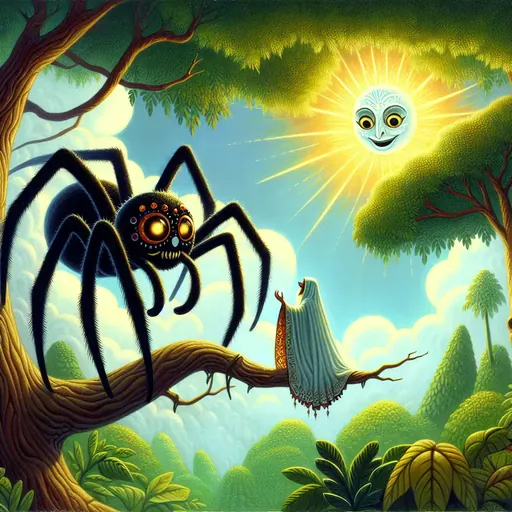
Anansi and the Sky God’s stories
Long ago, in this tale of the Ashanti people of Ghana, every story in the world belonged to Nyame, the Sky God. Anansi the spider asked to buy them, and Nyame named a price no one had ever paid: Onini the python, Osebo the leopard, the Mmoboro hornets and Mmoatia the fairy. Using his wits instead of his strength, Anansi tricked and caught them all, and Nyame gave him the stories.
That is why, among the Akan of Ghana, stories are still called Anansesem, “spider stories”. The tales crossed the Atlantic with enslaved Africans, which is why the Caribbean tells them too.
Moral Cleverness can win where strength cannot.
Read our retelling: Anansi's Great Story QuestRead our retelling: Anansi's Big Bet
What are some famous folktales from around the world?
Famous folktales from around the world include the Anansi stories from Ghana, Momotarō from Japan, Tenali Rama from India, The Giant Turnip from Russia and Stone Soup from Europe.
| Folktale | From | What it is about |
|---|---|---|
| Anansi stories | Ghana and the Caribbean | A clever spider who outwits stronger animals |
| Momotarō, the Peach Boy | Japan | A boy born from a peach sets off with animal friends to defeat the ogres |
| The Tale of the Bamboo Cutter | Japan | A girl found inside a shining bamboo stalk, who one day returns to the moon |
| Tenali Rama | India | A witty court poet who solves the king’s problems with clever tricks |
| Ali Baba and the Forty Thieves | The Thousand and One Nights | A woodcutter finds a thieves’ cave that opens with “Open, Sesame!” |
| The Giant Turnip | Russia | Everyone pulls together to pull up one enormous turnip |
| The Mitten | Ukraine | Animal after animal squeezes into a lost mitten |
| The Three Billy Goats Gruff | Norway | Three goats get past a troll by their wits |
| Sang Kancil | Malaysia and Indonesia | A small mouse-deer who outwits crocodiles and tigers |
| Brer Rabbit | African American folklore | A small rabbit who tricks bigger animals |
| The Gingerbread Man | The United States | A runaway cookie: “Run, run, as fast as you can!” |
| Stone Soup | Europe | Hungry travellers get a whole village to share its food |
Who collected folktales?
Folktales were collected by people such as the Brothers Grimm in Germany, Asbjørnsen and Moe in Norway and Alexander Afanasyev in Russia, who wrote down what others told them. They did not invent the tales.
| Collector | Where | First published | The book |
|---|---|---|---|
| The Brothers Grimm | Germany | 1812 | Children’s and Household Tales |
| Peter Christen Asbjørnsen and Jørgen Moe | Norway | 1841 | Norwegian Folktales, with The Three Billy Goats Gruff |
| Alexander Afanasyev | Russia | 1855 | Nearly 600 tales, with Vasilisa the Beautiful |
| Joseph Jacobs | England | 1890 | English Fairy Tales, with The Three Little Pigs |
| R. S. Rattray | Ghana | 1930 | Akan-Ashanti Folk-tales, in Twi and English |
| Zora Neale Hurston | Florida | 1935 | Mules and Men, African American folklore |
What is the difference between a folktale, folklore, a myth and a legend?
Folklore is everything a people passes on, and a folktale is one kind of story within it, told as fiction, while myths and legends are told as true. William Thoms coined the word “folklore” in 1846, and William Bascom wrote in 1965: “Folktales are prose narratives which are regarded as fiction.”
| Kind of story | Told as | When | Where | Who is in it |
|---|---|---|---|---|
| Myth | Fact, and sacred | The remote past | Another or earlier world | Gods and other non-humans |
| Legend | Fact, sacred or not | The recent past | The world of today | Human heroes |
| Folktale | Fiction, not sacred | Any time | Any place | People or animals |
Ashanti tellers said so out loud: R. S. Rattray reported in 1930 that a teller opened with “We don’t really mean to say so; we don’t really mean to say so.” Scholars still argue about the lines, and the folklorist Stith Thompson treated myths as one type of folktale.
Why are folktales good for children, and at what age?
Folktales are good for children from about age three, because they are made to be heard, they are short, and their small heroes win by being clever or kind.
- They are made to be heard. Repetition and refrains let children join in before they can read.
- They travel. Comparing tales from two countries is one of the best first lessons in other cultures: try The Giant Turnip beside The Mitten.
- Small heroes win. In folktales the youngest, the poorest or the smallest often wins by being clever or kind, which children love.
- Choices have results. August House points out that good decisions pay off and poor ones backfire, as in The Little Red Hen.
- They are short. Most can be told in five minutes, at bedtime or in the car, without a book.
Schools use them too. The US Common Core asks Grade 2 to recount “fables and folktales from diverse cultures”, and England’s national curriculum asks Years 1 and 2 to get to know “fairy stories and traditional tales”.
How do you tell a folktale aloud?
To tell a folktale aloud, learn its shape rather than its words, keep the repeated lines, and give each character a voice.
- Learn the shape, not the words. Remember the beginning, the three big moments and the ending; tell the rest in your own words.
- Keep the repeated lines. They are the bones of the story, and children will start saying them with you.
- Give each character a voice. A deep voice for the giant, a squeaky one for the mouse.
- Pause before the trick. Let children guess what the clever hero will do.
- End with a question. “Who was cleverer?” or “What would you have done?”
My folktale
- Where my folktale comes from:
- The hero:
- The problem or the trick:
- The line everyone repeats:
- How it ends:
- What it teaches:
pyxino.com
Or end the old way. R. S. Rattray’s Ashanti tales close with: “This, my story, which I have related, if it be sweet, (or) if it be not sweet, take some elsewhere, and let some come back to me.”
Where can children read folktales for free?
Children can read illustrated folktales for free on Pyxino, many of them read aloud. For an old collection, Project Gutenberg has Joseph Jacobs’s English Fairy Tales.
Start with these, from Ghana, Japan, India and the Thousand and One Nights:

Questions
What is the difference between a folktale and a fairy tale?
A traditional fairy tale is a kind of folktale, but not every folktale is a fairy tale. A fairy tale has magic; a folktale can be about ordinary people, clever tricks or funny mistakes.
What is the difference between folklore and a folktale?
Folklore is everything a group of people shares and passes on, including tales, proverbs, jokes and festivals. A folktale is one part of folklore: a traditional story told aloud. William Thoms coined the word “folklore” in 1846.
Who wrote folktales?
Nobody, and everybody: folktales were made up and changed by many tellers over centuries. Collectors like the Brothers Grimm wrote them down, but they did not invent them.
Are folktales true?
No. Folktales are told as made-up stories, even when they mention real places. Legends are the traditional stories told as if they might be true.
What is a trickster tale?
A trickster tale is a folktale in which a small, clever character, like Anansi the spider or the mouse-deer Sang Kancil, outwits bigger and stronger ones, often with a lesson hidden in the joke.
What age are folktales for?
Short folktales with repetition, like The Gingerbread Man or The Giant Turnip, suit children from about three. Trickster tales and longer folktales delight children up to ten and beyond.
More guides
- What is a fable?A fable is a short story, usually with animals that talk and act like people, that teaches a moral lesson.
- What is a fairy tale?A fairy tale is a short story of magic and wonder, in which ordinary heroes meet witches, fairies, giants or talking animals and good usually wins.
- What is the moral of a story?The moral of a story is the lesson it teaches about how to live, such as “slow and steady wins the race”.
- What is a myth?A myth is a traditional story, often sacred, that explains how the world began, why nature behaves as it does or where a people’s customs come from.


More stories:Classic talesAdventure


